|
|
| "Beauté
Bizarre" by C.B.Smith, Ed., Barfing
Frog Press The following is an interview between C.B.Smith of the Barfing Frog Press and contemporary American artist Don Swartzentruber. Awarded a grant from the Indiana Arts Commission and the National Endowment for the Arts, Swartzentruber submersed his labors into a rather playful exploration of caricature and grotesque. The collection being scheduled for international exhibition is titled "Esque: Carnivalesque & Grotesque". It consists of an artist's book that disassembles into individual images for display, a film short, and a collection of collaborative drawings.  CB: How would you define grotesque as applicable to this collection of work? Don: Fantastic distortion. It manifests as whimsy, satire, it at times transgresses, reflects the sublime, and often suggests mortality. CB: The first five pages of the book are transparency film photocopies from sketchbooks depicting exactly that, fantastic distortion monstrosities! Don: Yes, sketchbooks are occasionally published. My sketchbooks are a place for conceptualization, and not typically for exposition. There is a strong public appreciation for the artistic process and creative journey. Curators secure large audiences for Renaissance cartoons. DVDs for animated features frequently include early sketches from the character design team as a bonus feature. Since sketchbooks are documentaries of the artist's movements, I include evidence of past grotesque drawings to introduce this project. CB: Why the title Out of the Basement for the first chapter? Don: The basement of a museum or residential location is a private place for storage. These sketches span a decade and I have brought them up and out. CB: You included five pages of portraiture that seem to focus on expressions and ethnicity. Explain their inclusion. Don: In a portrait commission there are expectations. It is liberating to render the human face in a context such as this. Achieving a likeness was subservient to portraying emotion. Some of the models were from an undergraduate watercolor class I teach, and never saw the finished sketch.  CB: How does ethnicity fall into this study? Don: Consider the grotesque spectacle the Spaniard soldiers must have been to the Aztecs. Buffalo Bill Cody earned ticket money with his band of wild Native Americans, Filipinos, and Mexicans during the early circus era. Many of the women in his shows were painted to look oriental. As a Caucasian I appeared rather freakish to oriental children when I was in the Philippines. Microevolution showcases Homo sapiens with a wonderfully diverse palette of noses, eyes, and hair. Genetics provides additional individuality. Even disease, injury, scars, and tattooing affects our visible embodiment. CB: In looking over the notes and text on the page, they are quotes dealing with portraiture. Is this a trickle over from your role as instructor? Don: I have worked as a professional caricature portrait artist since 1984 and have taught visual art since 1993. I threw in a few random quotes from researchers for this project to keep the focus on the portrait as object rather than specific person. CB: In your collection I see pastiche arrangements of fairly straightforward portraiture and others where the collage arrangement is of masks and faces that belong to the unseen world or at least a world invisible to most. As to the masks in this collection: are these direct portraits of existing masks or associative impressions assembled and arranged ad hoc into newly created masks. Don: Both. All the masks were rendered from trips to the Chicago Field Museum. I resolved the studies and added hybrids of my own articulation on the graph paper at the bottom. Masks demonstrate physiognomies and ritual with grand sensation. They demonstrate a wonderful tension between alter ego and a communal melodrama.  CB: With the work of Joel-Peter Witkin photographing corpses, and Joe Coleman's paintings suggesting that ugly can source beautiful paintings, where do you see yourself in the grotesque dialogue? Don: There is extraordinary beauty in every area of creation. Slimy skin, sharp fangs, warts and pimples are all part of an intelligent design that transfixes our gaze. In the Monsters and Myths chapter it's clear that my objective is not to stimulate a sense of disgust, but to celebrate grotesque. To compose characters that, with real DNA and a pulsing heart, could acquire an immediate audience with the entire world. CB: Some of these characters seem whimsical. Don: Humor and horror are akin. Not only in slapstick comedy, but also, the shame of one, is the laughter of another. CB: Two of the pages seem more zoological in their character development. Did you spend time in the Chicago Field Museum's taxidermy collection? Don: Yes, the Museum claims over 17 million zoological specimens. Obviously they are not all out on display, but it was difficult limiting my sources. Even before the hybridization of my pencil, animals are absolutely phenomenal in their individuality. Any alteration on my part really makes them dysfunctional and, as you suggested, whimsical. CB: Talk about the film clip your working on. Don: It is short, but will be a memorable feature of the exhibit. The eyes may be windows to the soul, but the face is a testimony human individuality. In this video the viewer is pulled in as awkward observer. Limited colors flash in as texture and pattern across his face. The dexterity of the human face is capable of countless expressions. But, any contortion that does not define an emotion seems repulsive, as it does not fit into a social context. The expressions in this film suggest mental or emotional damage. CB: Is this your first film project? Don: I studied character animation under Disney animator, Milt Neil, for a couple of years. I also worked as an Art Director at a TV station. As far as actual film work, my experience is limited. The idea for this project manifested and film was the only way to go. CB: In the Carnivalesque Collaboration there is a rather stark style jump. Don: Absolutely. In the tradition of the surrealist exquisite corps, I grouped young teenagers together and requested a five-minute sketch. Encircled, they corporately passed the work for sixty minutes. The results were very carnivalesque and frequently took on macabre qualities. I appropriated there drawing and their collaborative imagination became my source. I carefully reworked their drawing, adding clarity. Finally it was polished off with an ink brush and prismacolor. 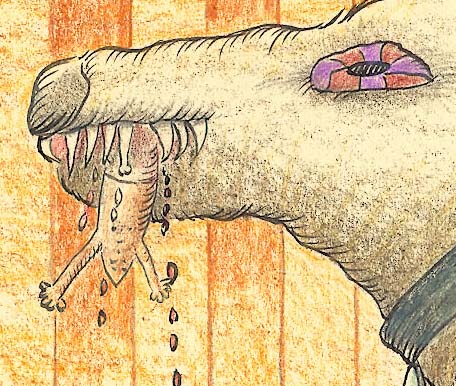 CB: They are rather Bosch like. Don: Yes. Bakhtin's literary critique discusses aspects of carnival. Looking over the random, and rather subconscious, narratives these kids created, it difficult to avoid the association. The work is indeed Bosch-like! CB: Is this work typical of the images that students create for you in other contexts? Don: Extremely different! CB: How do you account for this difference? Don: Several things. First, most of my teaching emphasizes life drawing. Second, students are working anonymously. I avoid standing behind them while they compose and give them no direction in regard to theme or narrative. I'm also convinced that there is a little graffiti artist in all of us. Who could avoid giving the Mona Lisa a mustache, or commit arsine to a rendered hotrod? What would that docile cow in the pasture look like with a party hat and bullet holes? CB: Don. Upon visiting your gallery one is immediately taken with the vast expanse of your artistic range. One sees concepts involving the grotesque, pop culture, religion, and marriage, to name a few and one senses the tremendous energy the spiritual and associative hold in your work. If you were to declare a manifesto that epitomizes your particular artistic position, what would it be? Don: A theme that runs through all of the work would be a personification of the grotesque making connections with the transcendent. Modernity spends a tremendous amount of effort advertising that there is no greater epiphany then human intellect and human sensuality. As an artist I have spent the past 23 years, since the age of 16, examining the human face by drawing caricatures. I find we, as humans, are rather awkward postulators. We are intellectual masks makers and wearers. While examining surface areas I also submerse to the soul. CB: How do you believe this work will be received in the fine art community? Don: Exclusive notions of fine art are changing. This is discussed in Vernedoe's book High & Low: Modern Art & Popular Culture. But, even in this text the writer felt obligated to justify caricature's validity primarily via high brow artists; Arcimboldo, Picasso, Brancusi, and Dubuffet. In today's contemporary art scene conceptual standards continue to elevate while the brows have started to drop. Art forms that were once excluded as outsider, folk or illustrative have found there way into museums and exhibitions. They are now recognized for their significant creative and cultural value. CB: In addition to viewing the work online, where might we expect to see the work? Don: Parts of the project was exhibited at the Midwest Museum of American Art and at a local faculty exhibit. I will make the collection available to national and international exhibit spaces. CB: Thanks and best wishes to you, and your future studio work. Don: My pleasure. Barfing Frog Press Interview © 2006 |
| Art Critic's Review of the "Surreal
No-Brow Pop Show" at The Spurious Fugitive LLC, South Bend Indiana "...Then there's Swartzentruber, whose multiple pieces are filled with eccentric characters in a strange, singular world with a distinctively postmodern flair. Three of the 25 pages from Swartzentruber's 'Artist's Book: Facing the Sublime and the Grotesque" are displayed here. The first, "Chapter 1: Out of the Basement, Page 5. Deaf and Dumb," features eight sketched figures on paper. The most interesting and disturbing: a gagged man, whose severed dagling limbs are connected to his torso by chains. "Chapter 2: Facing the Sublime and the Grotesque, Page 7: Facial Expressions" show 11 human faces, in whole or in part, displaying joy and laughter, hatred and indifference. "Chapter 4: Monsters and Myths, Page 19: Monster Mythical Creature (Trixters)," is perhaps the most captivating because it allows a glimpse into both the creative process and Swartzentruber's imagination. These character studies delve deep into a fantastic world where skin tones are blue, green and red, and facial features are distorted into myariad forms." - Jeremy D. Bonfiglio, "In a word: Weird", South Bend Tribune, South Bend, Indiana, Sunday, August 13, 2006, D4 © The Swartzentruber Studio | all rights reserved |
See the Grotesque Art Exhibition Earlier Bibliography - Support material that had influence on the work. Bakhtin, Mikhail. Rabelais and His World, Indiana University, 1984. Baltrusitas, Jurgen. Aberrations, MIT Press Bataille, Georges. Visions of Excess: Selected Writings, 1927-193, Minnesota, 1985. Benvenuti, Feliciano, ed. The Arcimboldo Effect: Transformations of the Face from the 16th to the 20th Century, New York: Abberville Press, 1987. Children of the Lost City. Culver City, CA: Columbia TriStar Home Video, 1996, French with English subtitles. Danow, David. The Spirit of Carnival: Magical Realism and the Grotesque, Lexington, KY: University Press of Kentucky, 1995. Frida. Los Angeles, CA: Connoisseur Video Collection, 1984. Spanish with English subtitles. Gargoyles: Gardians of the Gate, Washington, D.C. : New River Media, 1995. Jarmusch, Jim. Original Sin: The Visionary Art of Joe Coleman, New York: Gates of Heck, 1997. Jung, Carl. Man and His Symbols, Mendocino, CA : Audio Scholar, 1994. Madiff, Steven Henry. "Pop Surrealism", ArtForum International. Oct. 1998: 120-121. Mairowitz, David. Kafka, Northampton, MA: Kitchen Sink Press, 1994. Monestier, Martin. Human Oddities, New York: Carol Publishing, 1978. Oates, Joyce Carol. "Reflections of the Grotesque", Haunted: Tales of the Grotesque, The Ontario Review, Onterios, CA, 1994. The Seventh Seal, Ingmar Berman, Svenski Production, 1956. Swedish with English subtitles. Thomson, Rosemarie, Ed. Freakery: Cultural Spectacles of the Extraordinary Body, New York: New York University Press, 1996. Tuchman, Maurice and Carol S. Eliel. Parallel Visions: Modern Artists and Outsider Art, Princeton, NJ: Princeton University Press, 1993. Vernedoe, Kirk and Adam Gopnik. High &Low: Modern Art & Popular Culture, New York: Harry N. Abrams, 1990. Videlr, Tony. The Witkins, Joel-Peter. The Bone House, Sante Fe: Twin Palms Publishers, 1998. Young, Kathrine. Ed. Bodylore, Knoxville, TN: University of Tennessee Press, 1993. |